
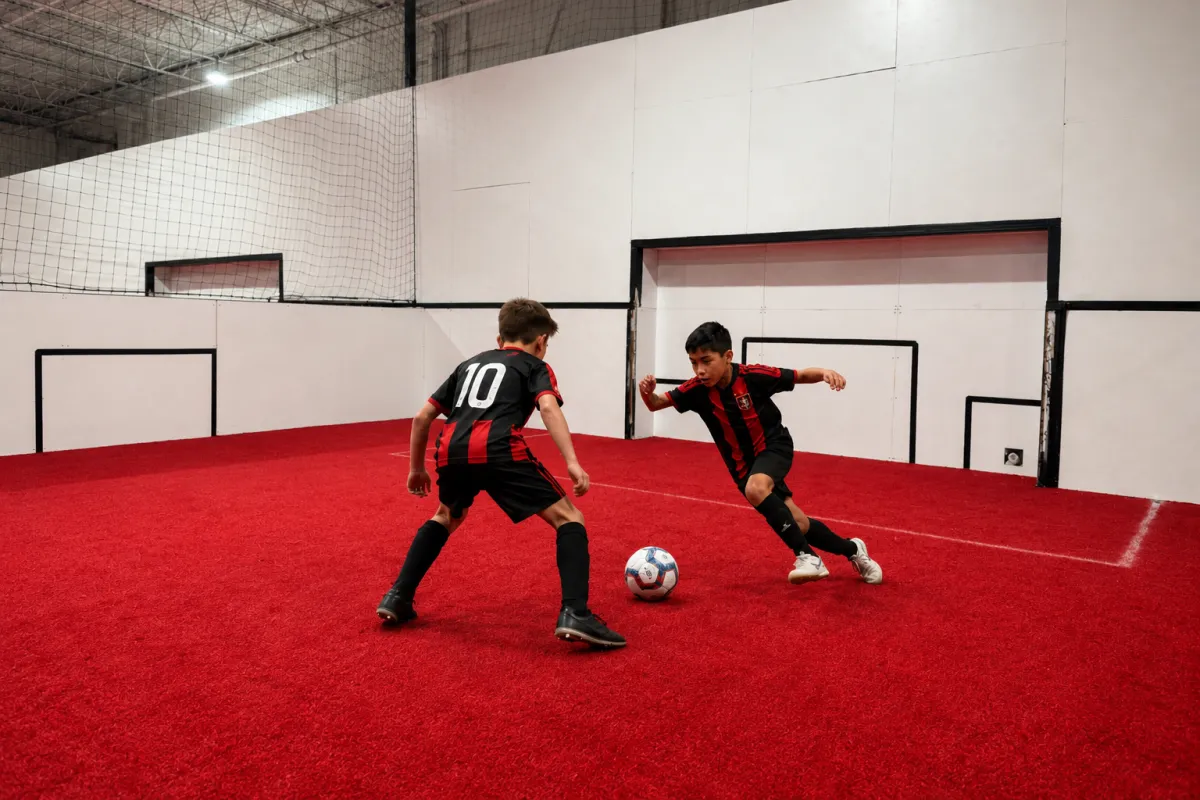
What Should a Good Soccer Practice Actually Look Like?
What Should a Good Soccer Practice Actually Look Like?
For most parents, soccer practice is something they either drop their child off at or watch from the sideline.
The field looks organized.
The kids are moving.
The coach is giving instructions.
The session looks active.
So it can be easy to assume one thing:
This must be good training.
But the truth is, not every active-looking practice helps players improve.
Some sessions look organized from the outside, but players spend too much time waiting, watching, or going through drills without really thinking. Other sessions may look faster, messier, or less polished — but they may be giving players exactly what they need to grow.
That is why one of the most valuable things a parent can learn is how to recognize what a strong training environment actually looks like.
Because once you know what to look for, the difference becomes clear.
Are Players Constantly Involved?
The first thing to watch is simple:
How often is your child actually involved?
Not just standing on the field.
Not just jogging from cone to cone.
Not just waiting for their turn.
Actually involved.
That means they are:
Touching the ball
Reacting to pressure
Making decisions
Moving with purpose
Staying connected to the activity
In many practices, involvement is limited. Players wait in lines, watch others go, or stand still while the coach explains the next drill.
Even if the session looks structured, that slows development.
A strong training environment keeps most players active most of the time. There is very little standing around, very few long lines, and the ball is constantly in play.
Because players improve by doing.
Not by waiting.
Are They Getting Meaningful Touches?
One of the clearest signs of a good practice is how often players are on the ball.
But it is not just about getting more touches.
It is about getting meaningful touches.
A meaningful touch happens when a player has to control the ball in a real situation. Maybe there is pressure nearby. Maybe they have to change direction. Maybe they have to decide whether to dribble, pass, turn, or protect the ball.
Those moments matter.
In some environments, a few players dominate the ball while others get limited opportunities. In others, the pace is slow, and players only touch the ball every so often.
Over time, that gap becomes development.
In a strong session, players are constantly involved with the ball. Repetition happens naturally through activity, not just through forced drills.
Because real skill is built through repeated, meaningful contact with the ball.
Are Players Being Asked to Think?
This is something many parents do not always notice at first.
How often does your child have to make a decision?
Soccer is not just about running, passing, or kicking. It is a game of constant decisions.
Where is the space?
Where is the pressure?
Should I dribble or pass?
Can I turn?
Can I beat this player?
What happens next?
In some practices, players have lots of time, very little pressure, and predictable patterns. That can look clean, but it does not always prepare players for the real game.
In stronger environments, players have to think more often. Pressure arrives quickly. Space changes. The game moves. Players have to adjust.
From the outside, both sessions may look active.
But the difference is how often each player is required to solve a problem.
Over time, those repeated decisions help players read the game, stay composed, and improve under pressure.
Because soccer is not just about having the ball.
It is about knowing what to do with it — quickly.
What Is the Coach Actually Doing?
Good coaching does not always mean more talking.
Some practices rely on constant instruction. The coach stops play often, tells players exactly where to stand, and controls every action.
That may look organized, but it can also create players who wait to be told what to do.
Strong coaching looks different.
A good coach sets up the right activity, keeps the game moving, watches closely, and steps in at key moments. They guide players without controlling every decision.
They ask questions.
They create challenges.
They allow mistakes.
They help players understand the game.
The goal is not to make players follow instructions perfectly.
The goal is to help players think, adjust, and improve.
Because confident players are not built by being told what to do every second.
They are built by trying, learning, and solving problems over time.
What Happens When Things Get Messy?
A good soccer practice will not always look perfect.
Players may lose the ball.
They may run into pressure.
They may make the wrong choice.
They may try something that does not work.
And that is okay.
In fact, that is often where real learning happens.
The question is not whether mistakes happen. The question is how the environment responds to them.
In some practices, mistakes are corrected immediately. Players are told to play safer, move the ball faster, or avoid risk. Over time, that can make players cautious.
In better development environments, mistakes are part of the process. Players are encouraged to keep trying, adjust, and learn from the moment.
That does not mean mistakes are ignored.
It means they are used.
When players are supported through mistakes, they become more confident, more creative, and more capable under pressure.
What Do the Players Look Like?
Finally, step back and look at the players themselves.
Not just what they are doing, but how they look.
Are they engaged?
Are they alert?
Are they involved?
Are they excited to play?
Are they thinking and reacting?
Or are they waiting, drifting, distracted, or going through the motions?
In a strong training environment, players rarely have time to switch off. They are too busy moving, reacting, adjusting, and playing.
That level of engagement matters.
Because when players are fully involved, they improve faster. They also enjoy the process more.
And when kids enjoy the process, they keep coming back.
So, What Should a Good Practice Look Like?
A good soccer practice is not defined by how organized it looks from the sideline.
It is defined by what each player is actually experiencing.
Are they constantly involved?
Are they getting meaningful touches?
Are they making decisions?
Are they learning under pressure?
Are they allowed to try, fail, adjust, and grow?
Those are the moments that build real players.
Not just players who can follow a drill.
Players who are confident, capable, creative, and comfortable in the game.
Over time, those moments add up.
And once you know what to look for, it becomes much easier to recognize the environments that truly help players grow.
Looking for This Type of Training Environment?
At Panther Soccer, our sessions are built around constant involvement, meaningful touches, decision-making, and real player development.
If you want your child in an environment designed to help them grow — not stand in lines — learn more about how Panther Soccer trains players.
