
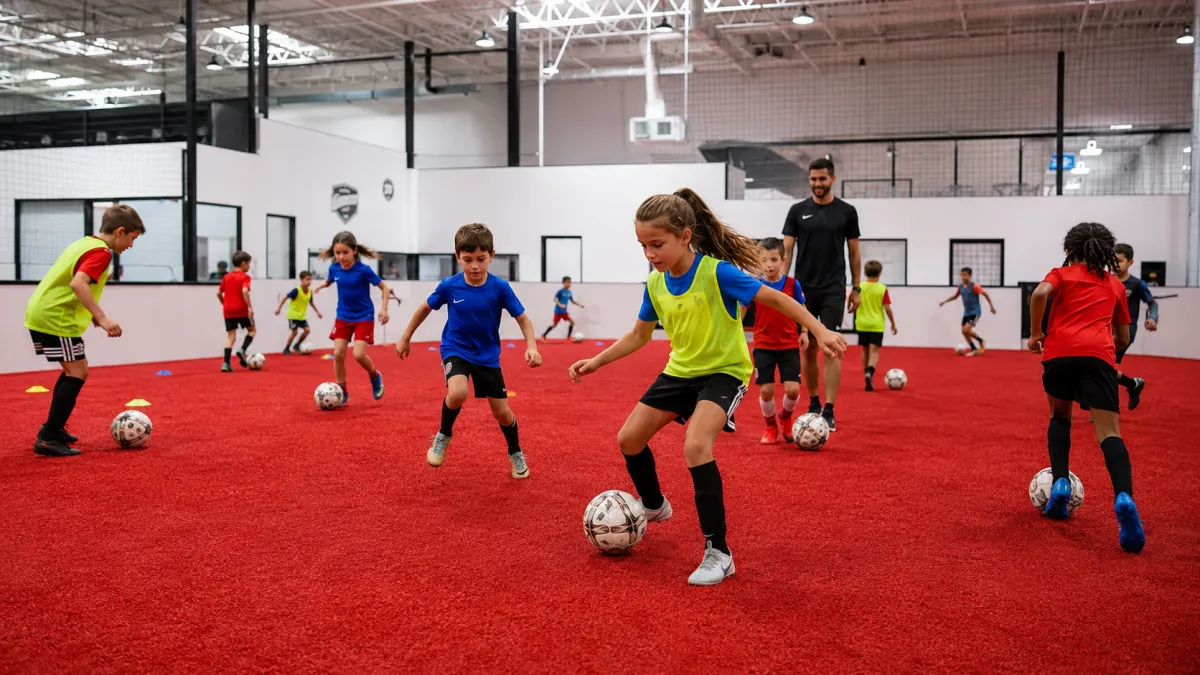
How to Help Your Child Improve Faster in Soccer
How to Help Your Child Improve Faster in Soccer
Most soccer parents want the same three things for their child.
They want to see them improve.
They want them to feel confident.
And they want them to love playing the game.
But player development does not always happen the way people expect.
Some kids play for years and barely change. They show up, practice, play games, and stay mostly the same.
Other players seem to grow quickly. They become more comfortable on the ball, more creative, more confident, and more excited to play.
So what makes the difference?
Most of the time, it is not talent.
It is the environment.
More specifically, it is what that environment allows your child to do every time they step on the field.
Improvement Starts With Involvement
The biggest factor in player development is simple:
How often is your child actually involved?
Not just running around.
Not just standing on the field.
Not just being part of a drill.
Actually involved.
That means they are:
Touching the ball
Making decisions
Reacting to pressure
Trying new things
Solving problems in real time
In many soccer practices, kids spend a surprising amount of time waiting in lines, watching other players, or moving through drills where they get only a few meaningful touches.
From the sideline, the session may look organized.
But organization does not always mean development.
Players improve by doing.
Not by waiting for their turn.
The more your child is involved, the more chances they have to learn. And the more chances they have to learn, the faster they improve.
Confidence Comes From Trying
A lot of youth soccer coaching focuses on instruction.
Stand here.
Pass there.
Go wide.
Don’t dribble.
Move the ball.
Instructions can help. But they do not create true confidence by themselves.
Real confidence comes from experience.
It comes from trying something, making a decision, seeing what happens, and learning from it.
That means players need space to make choices.
Space to try moves.
Space to make mistakes.
Space to solve problems.
Space to try again.
When players are constantly being told exactly what to do, they may look more organized in the moment. But they may not be learning how to understand the game for themselves.
When players are encouraged to think and act, they begin to recognize situations. They learn when to dribble, when to pass, when to protect the ball, and when to take a risk.
That is the kind of confidence that carries into games.
More Games Do Not Always Mean More Development
It is easy to assume that the more games a child plays, the faster they will improve.
Games matter.
They are fun, competitive, and important for applying skills.
But games alone do not always build better players.
In many games, the same patterns repeat. A few players dominate the ball. Some players barely touch it. Others get stuck in positions where they do not have many chances to make decisions.
That can make development uneven.
For most young players, the biggest growth comes from the right kind of training:
More repetition
More touches
More decision-making
More pressure
More chances to try and adjust
Then games become more valuable because players have tools they can actually use.
Training builds the foundation.
Games reveal it.
Fun Matters More Than Parents Realize
Kids improve faster when they enjoy what they are doing.
That does not mean practice should be random, easy, or unstructured.
It means the environment should make players want to come back.
The best training environments combine energy, challenge, creativity, and purpose.
Players should be active.
They should be engaged.
They should feel encouraged.
They should be challenged without feeling overwhelmed.
They should feel free to try things without being afraid of every mistake.
When kids enjoy the process, they train with more energy.
When they train with more energy, they get more out of every session.
And when they start seeing progress, they become even more motivated.
That is when development really accelerates.
The Right Environment Changes Everything
Every player develops at their own pace.
But the right environment can speed up that process in a big way.
Not by yelling more.
Not by pressuring kids harder.
Not by simply adding more games.
But by giving players what they need most:
More time on the ball
More meaningful touches
More decisions to make
More chances to solve problems
More freedom to try, fail, and improve
When those pieces are in place, improvement does not have to be forced.
It starts to happen naturally.
Players become more confident. They become more creative. They become more comfortable in the game.
And most importantly, they begin to enjoy the process of getting better.
Looking for This Type of Training Environment?
At Panther Soccer, our sessions are built around constant involvement, meaningful touches, decision-making, and player confidence.
If you want your child in an environment designed to help them improve faster and enjoy the game more, learn more about how Panther Soccer trains players.
