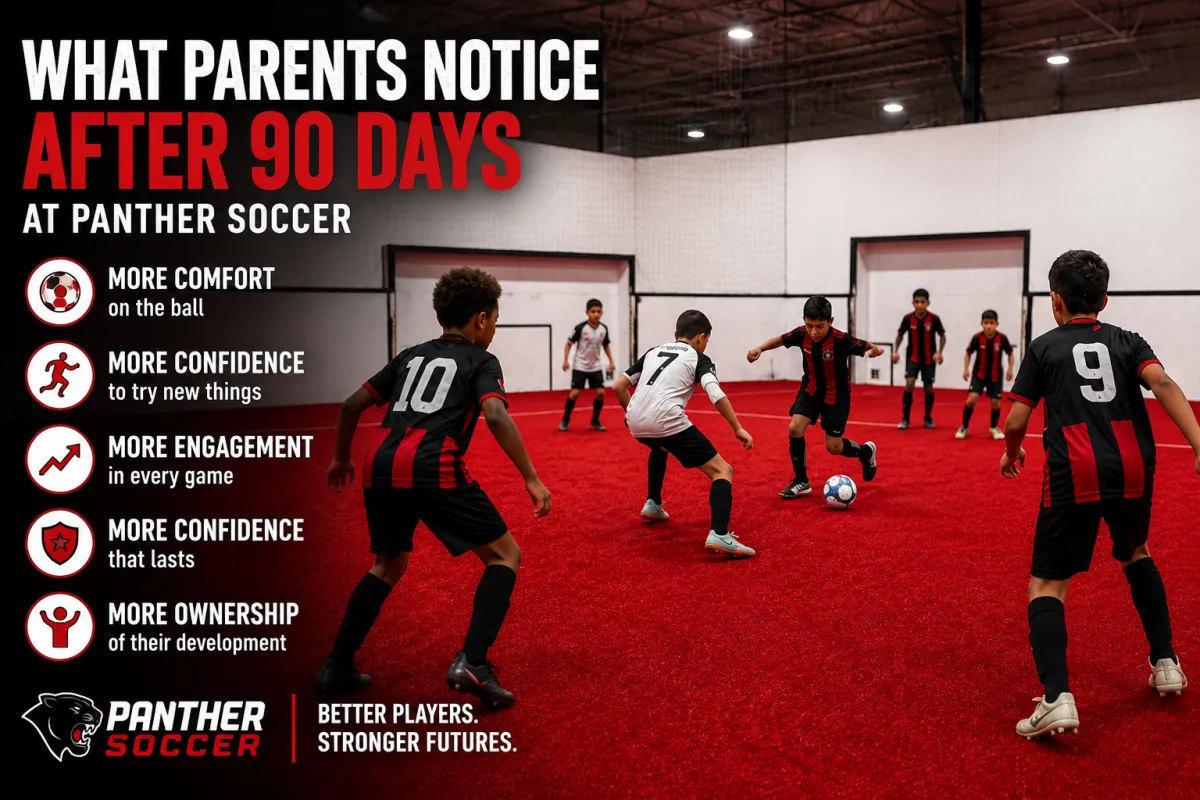
What Parents Notice After 90 Days at Panther Soccer
What Parents Notice After 90 Days at Panther Soccer
Most improvement in youth soccer does not happen all at once.
There usually is not one big moment where everything suddenly clicks.
Instead, parents start noticing small changes.
Their child asks to practice at home.
They look calmer with the ball.
They try a move in a game they never would have attempted before.
They stop hiding from pressure.
They start wanting the ball.
At first, those changes may seem small.
But over time, they add up.
And after a few months in the right training environment, many parents realize something important:
Their child is not just playing more soccer.
They are becoming a different kind of player.
They Look More Comfortable on the Ball
One of the first things parents notice is comfort.
Players who used to panic when pressure came near them begin to slow down. They stop treating the ball like something they need to get rid of right away.
They start keeping it longer.
They try turns and moves.
They receive passes with more confidence.
They look less rushed.
They begin to trust their feet.
For young players, this changes everything.
When a child feels comfortable with the ball, they become more involved in the game. They want the ball more often. They stop avoiding difficult moments. They begin looking for ways to solve problems instead of simply getting rid of the ball.
That is where real development begins.
They Start Trying Things
Many young players are taught early to play safe.
Do not lose the ball.
Pass quickly.
Do not dribble too much.
Do not make mistakes.
That may create a player who looks organized, but it can also create a player who becomes hesitant.
At Panther Soccer, players are encouraged to try, experiment, and learn through repetition.
At first, that process can look messy.
Moves do not always work.
Players lose the ball.
Decisions are not always perfect.
But that is part of development.
Over time, something starts to change.
Players begin trusting themselves.
Parents often notice their child becoming more creative, more expressive, and more willing to take risks during games.
They are not just following instructions.
They are learning how to play.
They Become More Engaged in Games
Another change parents notice is engagement.
Some kids spend large parts of games waiting for the ball, standing in safe spaces, or staying disconnected from the action.
As their confidence grows, that starts to change.
Players begin checking for the ball.
They move into space.
They demand possession.
They stay mentally connected.
They recover faster after mistakes.
They are no longer just watching the game happen around them.
They are participating in it.
That shift matters because the more involved a player becomes, the more chances they have to improve.
They Build Real Confidence
Confidence in soccer is often misunderstood.
It does not come from praise alone.
Real confidence comes from competence.
It comes from a player feeling:
I can handle the ball.
I can deal with pressure.
I can make decisions.
I can recover when I make a mistake.
That type of confidence is built through repetition, challenge, and experience.
And when it shows up, parents often see it beyond the field.
Their child may become more vocal.
More expressive.
More willing to take initiative.
More excited to talk about training and games.
Not because someone told them to be confident.
Because they genuinely feel more capable.
They Begin Taking Ownership
This may be the biggest change parents notice.
At some point, soccer stops feeling parent-driven.
The child starts caring about their own development.
They ask to practice.
They watch soccer at home.
They talk about moves, players, and games.
They want to get better.
They begin to see themselves as a soccer player.
That is a major turning point.
Because long-term development almost always follows ownership.
When a child enjoys the process and wants to improve for themselves, progress becomes much more powerful.
The Changes Add Up
Every player develops at a different pace.
Some changes happen quickly. Others take more time.
But after 90 days in the right environment, parents often notice more than just better foot skills.
They notice comfort.
They notice confidence.
They notice creativity.
They notice engagement.
They notice a deeper connection to the game.
Those changes matter because they last longer than one good game, one tournament, or one season.
They become part of who the player is becoming.
See the Panther Difference
At Panther Soccer, our training is built to help players get more meaningful touches, make more decisions, build confidence, and enjoy the process of improving.
If you would like to see what this environment looks like in person, learn more about Panther Soccer or book a trial today.
